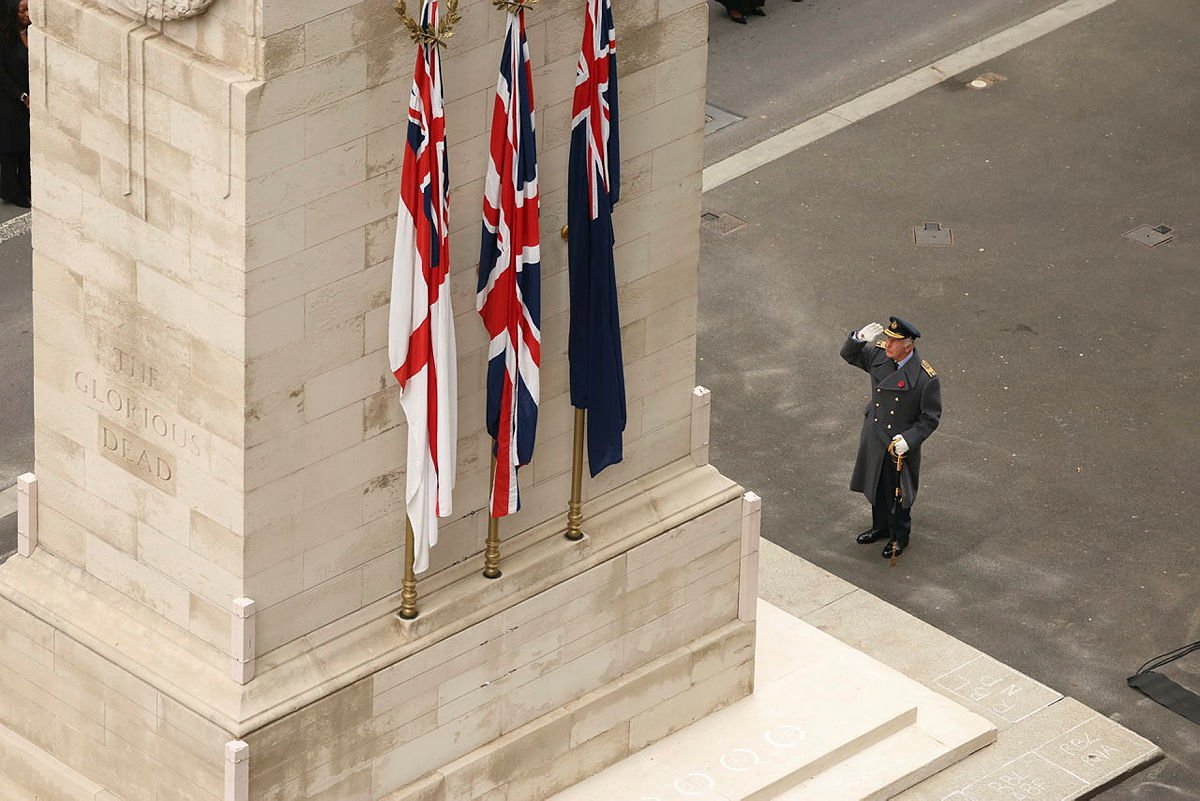
LONDON — King Charles III led Britain’s Remembrance Sunday commemorations on November 8, observing a two-minute silence and laying a wreath at the Cenotaph in central London, as around 10,000 veterans, including approximately 20 who served during the Second World War, gathered for the annual ceremony honouring those who died in conflict. At the first stroke of Big Ben at 11 a.m., the country fell silent for two minutes; ceremonial guns fired by the King’s Troop Royal Horse Artillery at nearby Horse Guards Parade marked the beginning and end of the silence, and buglers then sounded the Last Post.
Wearing the uniform of a Marshal of the Royal Air Force, with a greatcoat, cap and sword, the King laid the first wreath of red poppies — 41 paper poppy petals mounted on black leaves, closely resembling the wreath produced for King George VI — and saluted as he stepped back from the monument, beneath the words “The Glorious Dead.” The Prince of Wales laid a wreath after him, followed by other members of the Royal Family and senior political figures, while Queen Camilla and Catherine, Princess of Wales, both dressed in black, watched from the central balcony of the Foreign, Commonwealth & Development Office overlooking Whitehall. The service continued with prayers and a hymn, attended by Dame Sarah Mullally, the first female Archbishop of Canterbury.
This year’s service set a political record: nine former prime ministers stood together in Whitehall — Keir Starmer, Rishi Sunak, Liz Truss, Boris Johnson, Theresa May, David Cameron, Gordon Brown, Tony Blair and John Major — alongside Prime Minister Andy Burnham, attending his first Remembrance Sunday in office, and Reform UK leader Nigel Farage, who laid a wreath for the first time after his party reached the six-MP threshold for party leaders to participate. After the formal ceremony, veterans began their traditional march-past of the Cenotaph, with more than 300 military and civilian organisations represented and thousands of spectators lining the surrounding streets.
Among the oldest marchers was Annie Duplock, 103, who joined the Women’s Land Army in 1940 at 16 after lying about her age and spent four years helping maintain Britain’s food supplies — her first appearance in the Cenotaph procession, more than eight decades after the war. The Royal British Legion this year marked the 35th anniversary of the end of the 1990–91 Gulf War, in which 47 British personnel died, and 15 years since the conclusion of Operation Telic in Iraq, where 179 died. Remembrance Sunday, held on the second Sunday of November, commemorates the armistice that took effect at 11 a.m. on 11 November 1918; the Cenotaph — Greek for “empty tomb” — was unveiled in stone by King George V on 11 November 1920, and the red poppy, adopted by the Legion in 1921 after John McCrae’s “In Flanders Fields,” remains its symbol.
Sources: Nexus Europa / BBC reporting (ceremony, veterans and attendees); Royal Central (the King’s wreath and uniform)


